Is there a way to tell from the egg carton how old the eggs are? How long are eggs safe to eat? Here are the answers to some of your most common questions about eggs:
Is there a way to tell from the egg carton how old the eggs are?
To determine freshness, a pack-date calendar (or Julian Date calendar) can be used like the one below. This three-digit code indicates the date of packaging, starting with January 1 as 001 and ending with December 31 as 365. These numbers represent the consecutive days of the year. For example, an egg carton with a packaging date of 032, means the eggs were packed on February 1st. You can store fresh shell eggs in their cartons in the refrigerator for four to five weeks beyond this date.
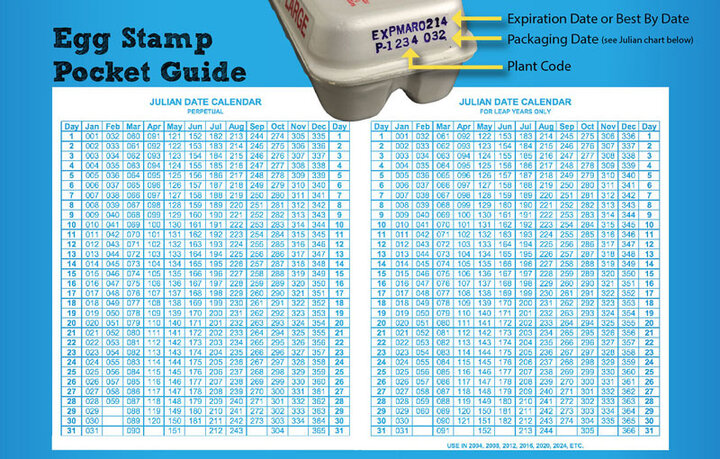
Source: United States Department of Agriculture (USDA)
Plants not under USDA inspection are governed by the state laws where the eggs are packed and/or sold. Most states require a pack date. For more information about state egg laws, contact your state's Department of Agriculture.
How long can I keep eggs that I purchased from the grocery store?
Always purchase eggs before the "Sell-By" or "EXP'" date on the carton. After the eggs reach home, refrigerate the eggs in their original carton and place them in the coldest part of the refrigerator, not in the door. For best quality, use eggs within 3 to 5 weeks of the date you purchase them. The 'sell-by' date will usually expire during that length of time, but the eggs are perfectly safe to use." Use of either a "Sell-By" or "Expiration" (EXP) date is not federally required, but may be state required, as defined by the egg laws in the state where the eggs are marketed. Some state egg laws do not allow the use of a "sell-by" date.
Is an egg that floats still fresh?
An egg can float in water when its air cell has enlarged sufficiently to keep it buoyant. This means the egg is old, but it may be perfectly safe to use. Crack the egg into a bowl and examine it for an off-odor or unusual appearance before deciding to use or discard it. A spoiled egg will have an unpleasant odor when you break open the shell, either when raw or cooked.
How do I cook eggs safely?
Proper cooking as well as proper storage is important for egg safety. Cook eggs thoroughly so both yolks and whites are firm, not runny. Casseroles and dishes containing eggs should be cooked to 160° F as measured by a food thermometer. Do not eat raw or undercooked eggs. Once eggs are hard-cooked, they should be refrigerated (in their shells) within 2 hours of cooking and used within a week. Refrigerate them in a clean container, not their original egg carton.
Sources:
A Carton of Eggs - A True Baker's Dozen, United States Department of Agriculture (USDA)
Food Product Dating, United States Department of Agriculture (USDA)/Food Safety and Inspection Service (FSIS)
Shell Eggs from Farm to Table, United States Department of Agriculture (USDA)/Food Safety and Inspection Service (FSIS)
This article has been peer-reviewed. It was originally written by Alice Henneman and Joyce Jensen. Reviewed in 2026 by Mary Kasten, UNMC professional student of Dietetics.